

How to Read a Rent Roll: A Buyer's Checklist
What a complete rent roll shows, how to tie it to the T-12 and bank deposits, and the California and Santa Barbara rules that decide what it's worth.

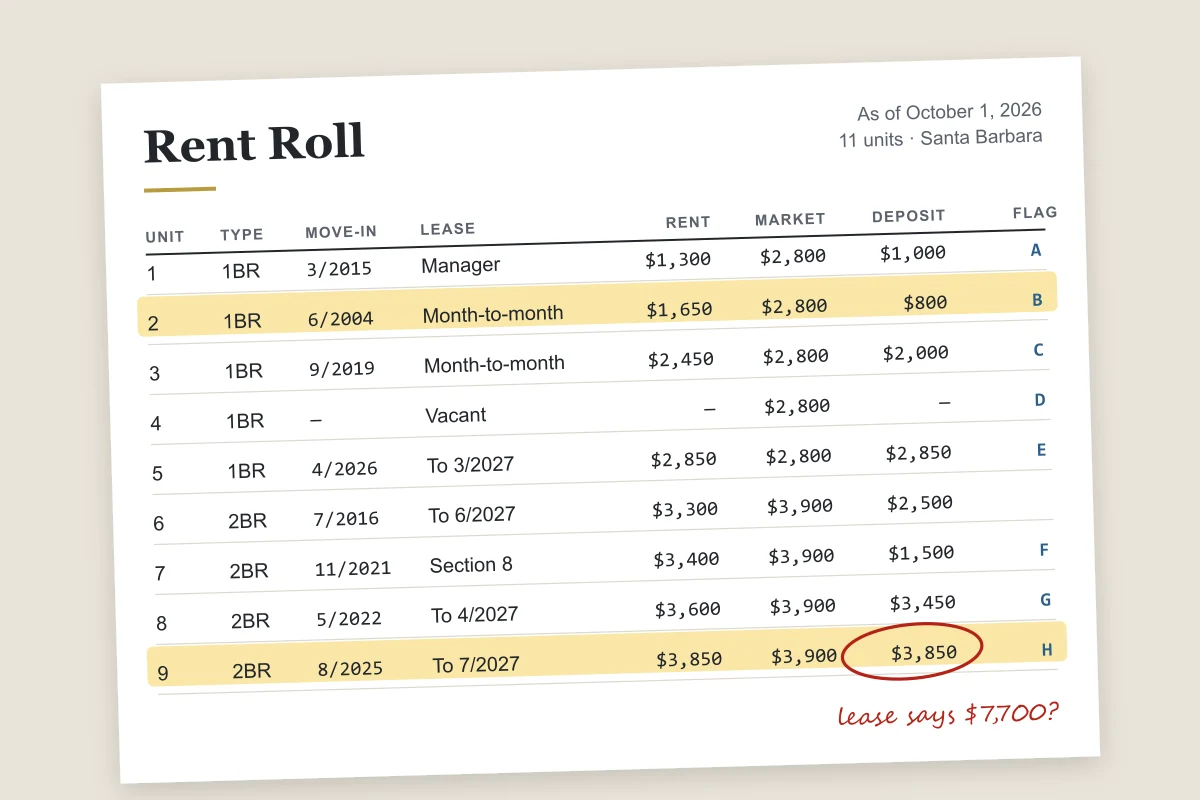
A rent roll exported from property-management software lists each unit's tenant, rent, deposit and lease dates. In the City of Santa Barbara, a buyer now needs one more number: each unit's rent on December 16, 2025.
That date anchors both the City's freeze on rent increases for most pre-1995 apartments, in effect since February 26, 2026, and the permanent rent ordinance the City Council adopted on October 6, 2026. For tenancies that began on or before December 16, 2025, that day's rent is the base rent every future increase is measured from, and increases taken since count against the ones the ordinance allows later.
Rent caps, deposit limits, Section 8 contracts, utility billing and rental registries now reach into almost every column of a California rent roll. Here is how to read one, for buyers and for sellers getting ready to sell.
At a glance
- A complete rent roll shows move-in dates, each tenant's last increase (date and amount), deposits, concessions and every charge besides rent.
- It should tie to the trailing-12 operating statement and to bank deposits. Whatever doesn't tie is your due diligence list.
- Loss-to-lease is worth what the rules let you capture: 2.1 percent in 2027 under Santa Barbara's adopted ordinance, 4 percent a year on covered Oxnard units, and up to 8.6 percent under AB 1482 elsewhere in Santa Barbara, Ventura and San Luis Obispo counties through July 2027.
- Deposits go with the building. Credit each one in escrow at the amount in the lease; since July 1, 2024, most can't exceed one month's rent.
What should a rent roll include?
| Field | Why it matters |
|---|---|
| Unit, bedrooms, baths | Check against County records for unpermitted units and added bedrooms. |
| Tenants and guarantors | Who is liable; in Isla Vista, the whole group. |
| Move-in date | AB 1482's just-cause protection starts at 12 months; in Santa Barbara, it decides which rent is the base rent. |
| Lease term or month-to-month | When each unit can be re-priced. |
| Rent, last increase date and amount | The next lawful increase depends on both. |
| Market rent | The gap to market, unit by unit. |
| Concessions, listed separately | Net effective rent. AB 1482 caps increases off the gross rent and requires the lease to show concessions separately. |
| Other charges | Parking, storage, utilities; in Santa Barbara, part of the regulated rent. |
| Deposit held | It transfers to the buyer. |
| Subsidy split | The tenant's share and the housing authority's share. |
| Balance owed | Chronic delinquency is vacancy you haven't priced. |
A sample rent roll: an 11-unit Santa Barbara building
An illustrative 1960s building inside Santa Barbara city limits, covered by the City's ordinance, with the rent roll dated October 1, 2026. Market rents sit near the City's 2026 survey medians for Santa Barbara apartments: $2,100 for a studio, $2,795 for a one-bedroom and $3,910 for a two-bedroom.
| Unit | Type | Move-in | Lease | Rent | Market | Deposit | Flag |
|---|---|---|---|---|---|---|---|
| 1 | 1BR | 3/2015 | Manager | $1,300 | $2,800 | $1,000 | A |
| 2 | 1BR | 6/2004 | Month-to-month | $1,650 | $2,800 | $800 | B |
| 3 | 1BR | 9/2019 | Month-to-month | $2,450 | $2,800 | $2,000 | C |
| 4 | 1BR | — | Vacant since 8/2026 | — | $2,800 | — | D |
| 5 | 1BR | 4/2026 | To 3/2027 | $2,850 | $2,800 | $2,850 | E |
| 6 | 2BR | 7/2016 | To 6/2027 | $3,300 | $3,900 | $2,500 | — |
| 7 | 2BR | 11/2021 | Section 8 | $3,400 | $3,900 | $1,500 | F |
| 8 | 2BR | 5/2022 | To 4/2027 | $3,600 | $3,900 | $3,450 | G |
| 9 | 2BR | 8/2025 | To 7/2027 | $3,850 | $3,900 | $3,850 | H |
| 10 | 2BR | 3/2026 | To 2/2027 | $3,900 + $85 RUBS | $3,900 | $3,900 | I |
| 11 | Studio (rear) | 2/2018 | Month-to-month | $1,900 | $2,100 | $1,500 | J |
The occupied units pay $28,200 a month; all 11 at market would bring $35,600. Deposits on the roll total $23,350, but the leases add up to $27,200.
- A. Manager. The $1,500 discount is payroll, not loss-to-lease. California requires an on-site manager only at 16 or more units (25 CCR §42); check whether the apartment is tied to the job in writing.
- B. Long tenure. Under the adopted ordinance, the rent can rise 2.1 percent in 2027; the rest of the gap waits for turnover.
- C. Month-to-month. After 12 months of occupancy, state law and the City's own just-cause rules require just cause to end a tenancy, lease or no lease. The flexibility is the tenant's.
- D. Vacancy. Ask how it emptied. Under state law, a tenant who left on a no-fault notice for a substantial remodel must be offered the unit back at the old rent if the work isn't started or finished.
- E. Concession. One free month makes the effective rent about $2,613, below market.
- F. Section 8. $1,020 from the tenant and $2,380 from the housing authority (below).
- G. A 2026 increase. Raised from $3,450 on February 1, 2026, before the freeze. Under the ordinance, the base rent stays $3,450, and the 4.3 percent increase uses up 2027's 2.1 percent adjustment.
- H. Deposit. The lease says $7,700: two months' rent on a 2025 lease, over the legal limit. Credit $7,700 in escrow, or have the seller refund the excess first.
- I. RUBS. The charge started with the lease. Added to an existing covered tenancy, it would be a rent increase.
- J. Unpermitted unit. County records show 10 units (below).
How do you check a rent roll against the T-12 and the bank?
A rent roll is a snapshot; the trailing-12 operating statement (T-12) shows what came in over the year, and bank statements prove it. Multiply the rent roll by 12 (in the sample, $338,400 from the occupied units) and account for the difference from the T-12's rental income: vacancy, concessions, bad debt and rent changes. Then match two or three recent months to bank deposits, tenant by tenant where the ledgers allow. Housing-authority payments arrive as separate deposits.
Whatever doesn't tie becomes a question: T-12 income missing from the rent roll, cash rent, units rented to the owner's family or employees, or a cluster of higher-rent leases just before the sale. Ask for tenant ledgers and an aged delinquency report.
Loss-to-lease: how rent caps slow the path to market
Loss-to-lease is the gap between market rent and rent in place: $4,600 a month in the sample, 14 percent of the occupied units' $32,800 market rent. But $1,500 of that is the manager's discount, and $1,150 is Unit 2 alone.
How fast Unit 2's $1,650 reaches $2,800 depends on the rule. Annual increases needed at each rule's current maximum, even if market rents never move:
| Rule (covered units) | Current maximum | Increases to reach $2,800 |
|---|---|---|
| City of Santa Barbara | 2.1% for 2027 (60% of CPI, never more than 3%) | 26 |
| Oxnard | 4% a year | 14 |
| AB 1482 (most other older buildings in Santa Barbara, Ventura and SLO counties) | 8.6% from August 1, 2026 to July 31, 2027 (5% plus CPI, never more than 10%) | 7 |
In a covered Santa Barbara unit, the gap really closes at turnover, when state law lets the owner set a new tenant's starting rent. We underwrite covered buildings on in-place rents and treat the market column as what turnover may bring, not what a buyer can count on. The ordinance also withholds the annual adjustment from a unit that isn't kept habitable or has unfinished repairs ordered by a court or the City.
Registries, Section 8, utility billing and deposits
Rental registries in Santa Barbara and Oxnard
- Santa Barbara (Chapter 26.100). Under the adopted ordinance, nearly every rental unit, covered or not, must be registered with its current rent, last increase and the tenant's move-in date, under penalty of perjury: covered units by April 1, 2027 and others by October 1, 2027 (or 30 days after the City posts the form, if later). A buyer must amend the registration within 30 days and notify every tenant. From 2028, an owner without an accurate registration can't collect rent, raise it or evict. Our owner guide to the ordinance tracks its status, including the referendum effort.
- Oxnard. Registration has been required since 2025. Rent-increase and eviction notices must be filed through the registry within five days of service. More in our Oxnard guide.
If the rent roll and the registry disagree, one of them is wrong, and in Santa Barbara the registry is the sworn one.
Section 8 units
Part of a voucher unit's rent comes from the housing authority under a Housing Assistance Payments (HAP) contract, which can't be assigned to a buyer without the authority's written consent (HUD form 52641). Rent increases need 60 days' notice to the authority and must pass its rent-reasonableness review, and changing who pays a utility requires a new contract (24 CFR 982.308 and 982.507). In Santa Barbara, a voucher unit whose contract rent is at or below the Housing Authority's payment standard is exempt from the City's rent limits while it stays in the program. Ending or not renewing a contract takes 90 days' notice to the tenant (Civil Code §1954.535) and, under local rent control, can bar resetting that unit's rent for three years (§1954.53). Refusing a tenant because of a voucher is illegal (Government Code §12955).
Utility billing: RUBS and submeters
Submetered water follows Civil Code §§1954.201–1954.219: written disclosure before the lease is signed, billing at the water provider's rates, and an administrative fee capped at the lesser of $4.75 (adjusted for inflation) or 25 percent of the usage charge.
RUBS, which splits a master bill by unit size or occupancy, falls outside that chapter, and a 2025 bill that would have banned it for anything but water and sewer (AB 1248) died in February 2026. Confirm every RUBS charge is in the lease and underwrite what the bank shows. In Santa Barbara, payments for utilities, parking and storage count as rent, so adding a utility charge to an existing covered tenancy is a rent increase.
Security deposits
Since July 1, 2024, a deposit generally can't exceed one month's rent, on top of the first month's rent (AB 12). The two-month exception covers only an individual, or an LLC owned by individuals, with no more than two rental properties and four rental units in total, so it can't apply to a building with five or more rental units. Deposits collected earlier are unaffected. AB 2801 added photos: at move-out, before and after any repairs or cleaning to be deducted (since April 1, 2025), and at move-in for tenancies starting July 1, 2025 or later. Deductions need them, so ask for the files.
At a sale, the seller must give the buyer a written statement of the deposits, then transfer each one to the buyer, with notice to the tenant, or return it. If that doesn't happen, the buyer is generally jointly liable for the deposits (Civil Code §1950.5).
Isla Vista rent rolls: bedrooms, groups and guarantors
Isla Vista rents are set by the bedroom (see our Isla Vista investing guide), so its rent rolls need extra checks:
- Bedrooms against permits. A unit leased as three bedrooms but permitted as two is a disclosure item and a price discount. Since July 1, 2026, the County has also sized owner-paid trash service to bedroom count.
- Groups and guarantors. Most houses and many apartments lease to a group on one joint-and-several lease, often with guarantors. Confirm the guaranties carry over to a new owner.
- Next year's leases. Leasing for the next academic year starts months ahead, so a spring sale is largely a sale of next year's signed leases. Ask for both years.
- Returning roommates. AB 1482 allows a fresh rent only when no tenant from the prior tenancy remains. One holdover roommate keeps the cap on.
- Deposits. With several adult tenants, the deposit goes back by one check payable to all of them unless they all agreed otherwise in writing.
Unpermitted units, estoppels and lease audits
Unpermitted units. Compare the rent roll's unit and bedroom counts with the County Assessor's records and the City's permit file. For a seller, our advice is to disclose an unpermitted unit and sell as is: a permit started before listing puts the whole building in front of an inspector, and legalizing a unit in Santa Barbara commonly takes many months and can take well over a year. For a buyer, the income is real but at risk, and a lender or appraiser may not count it. Santa Barbara's ordinance still treats it as a rental unit "with or without a valid certificate of occupancy," so it must be registered.
Estoppels and the lease audit. Send an estoppel certificate to every tenant, and require a certified rent roll in the purchase contract for any that don't come back. On a building this size, read every lease, addendum and rent-increase notice. On a large property, read every lease the rent roll flags plus a random sample, and widen the sample if it finds errors.
Rent roll red flags
- Rents at or above market with no concession shown.
- New leases at higher rents just before a sale.
- Deposits that don't match the leases or exceed the one-month limit.
- More units or bedrooms than County records show.
- Santa Barbara increases after December 16, 2025, or RUBS added to existing tenancies.
- The owner's family or employees in units at unexplained rents.
Frequently asked questions
What should a rent roll include?
Unit and bedroom count, every tenant and guarantor, move-in date, lease term, current rent, the last increase (date and amount), market rent, concessions, other charges such as parking and utilities, the deposit held, any subsidy split and the balance owed. In the City of Santa Barbara, add each unit's rent on December 16, 2025, the base rent for tenancies that began by then.
What is loss-to-lease on a rent roll?
Loss-to-lease is the gap between market rent and what tenants actually pay. It's upside only if the rules let you capture it. Under the rent ordinance Santa Barbara adopted in October 2026, annual increases on covered units are limited to 60 percent of CPI, never more than 3 percent (2.1 percent for 2027), so most of the gap closes only when a tenant moves out.
How do you verify a rent roll?
Tie it three ways: multiply it by 12 and compare it to the trailing-12 operating statement, match recent months to bank deposits, and check it against the leases and tenant estoppel certificates. Differences should trace to vacancy, concessions, bad debt or rent changes. Anything else needs an answer before contingencies come off.
What is a tenant estoppel certificate?
A tenant's signed statement confirming the rent, deposit, lease dates, concessions and any side agreements, so a buyer and lender can rely on them. Buyers ask the seller to send one to every tenant during due diligence. Because some won't come back, the purchase contract should also require a certified rent roll, signed by the seller.
How much can a landlord collect as a security deposit in California?
Since July 1, 2024, generally no more than one month's rent on top of the first month's rent (Civil Code §1950.5, as amended by AB 12). An individual, or an LLC owned by individuals, with no more than two rental properties and four rental units in total may take two months' rent, unless the tenant is a service member. Earlier deposits aren't affected.
How we use the rent roll in an opinion of value
Every opinion of value we write starts with the rent roll. Each unit gets three rents: today's, next year's under the rule that governs it, and market, which we never set below the highest rent already in place for that unit type. We rebuild expenses from the owner's statements, with property taxes at a buyer's reassessed basis, and price against our own closed sales. To see what your rent roll says about value, request a free opinion of value or contact Steve Golis (DRE #00772218), Jack Gilbert (DRE #02197493) or Aneta Jensen (DRE #01994822) at Radius Commercial Real Estate.
Sources
- California Civil Code §1947.12 (AB 1482 rent cap, concessions, new tenancies) and §1946.2 (just cause)
- California Civil Code §1950.5 (security deposits), as amended by AB 12 (2023) and AB 2801 (2024)
- California Civil Code §§1954.201–1954.219 (water submetering) and AB 1248 (2025–26)
- California Civil Code §1954.53 and §1954.535; Government Code §12955
- 25 CCR §42 (resident manager requirement)
- 24 CFR Part 982 (§982.308 lease and rent changes, §982.507 rent reasonableness) and HUD form 52641, the HAP contract
- City of Santa Barbara, Rent Stabilization program (2027 annual adjustment, rent increase moratorium), and the adopted Chapters 26.90 and 26.100 (October 6, 2026)
- City of Santa Barbara, 2026 Rent Survey for the South Coast (May 26, 2026)
- California Department of Industrial Relations, California Consumer Price Index
- City of Oxnard, Rent Stabilization and Rental Registry
- Noozhawk, "County Supervisors Establish New Trash Service Requirements for Isla Vista" (February 24, 2026)
This article is general information, not legal advice.