

Your Rents Are Capped. Your Tax Bill May Not Know It Yet.
Rent control is pushing Santa Barbara apartment values down. Owners who bought before it was priced in can ask for a Prop 8 property tax review.

A version of this article appeared in the Montecito Journal, October 2026.
Last December, during a marathon City Council session on rent control, Councilmember Kristen Sneddon described where an apartment building's value comes from: "Where the wealth generated in this property comes from is not from the rents. It's from the increased value of the property just by existing over time."
California's property tax system makes the same assumption. For anyone who bought an apartment building between 2021 and the middle of 2025, it may not hold right now. On October 6, the council gave final approval to the rent stabilization ordinance, 4 to 3. Much has been said about the cap itself. Far less has been said about what it does to values, and almost nothing about how those values flow back to your property tax bill.
At a glance
- Prop 13 values only go up on their own. Your assessed value starts at your purchase price and rises up to 2 percent a year. It comes down only through a Prop 8 review, and for an apartment building that usually means asking for one.
- Rent control is pulling values down. By our count, City apartment buildings sold at an average cap rate of 4.93 percent in 2025 and 5.31 percent through September 2026, against the mid-3 percent range at the 2021–2022 peak.
- Buyers from 2021 to mid-2025 are the most exposed. Seven of the eight peak-era City sales we checked are still taxed at their purchase price plus the annual increases.
- This year's deadlines are close: November 16 for an informal review with the County Assessor, and November 30 for a formal appeal ($65 per parcel).
Prop 13 sets two limits: 1 percent and 2 percent
Prop 13 limits your property tax in two separate ways, and it helps to keep them apart.
The first limit is the tax rate. The general property tax is capped at 1 percent of your assessed value. Your bill runs a little higher because Prop 13 lets voters approve bonds on top of that 1 percent. In most of the City, school and college bonds add about 0.05 percent, so a typical Santa Barbara apartment owner pays about 1.05 percent of assessed value, plus a few small fixed charges.
The second limit is the assessed value itself. It starts at your purchase price and can rise by no more than 2 percent a year, whether or not your building is worth more. So 1 percent is the rate, and 2 percent is how fast the value it applies to can grow. A $5 million assessment at about 1.05 percent is a bill of about $52,500. Next year the assessment can rise to $5.1 million, and the bill rises with it.
Prop 8, passed the same year, adds the exception that matters now: if your building's market value on January 1 falls below that Prop 13 value, you are entitled to be taxed on the lower number.
Taxes, NOI and value move together
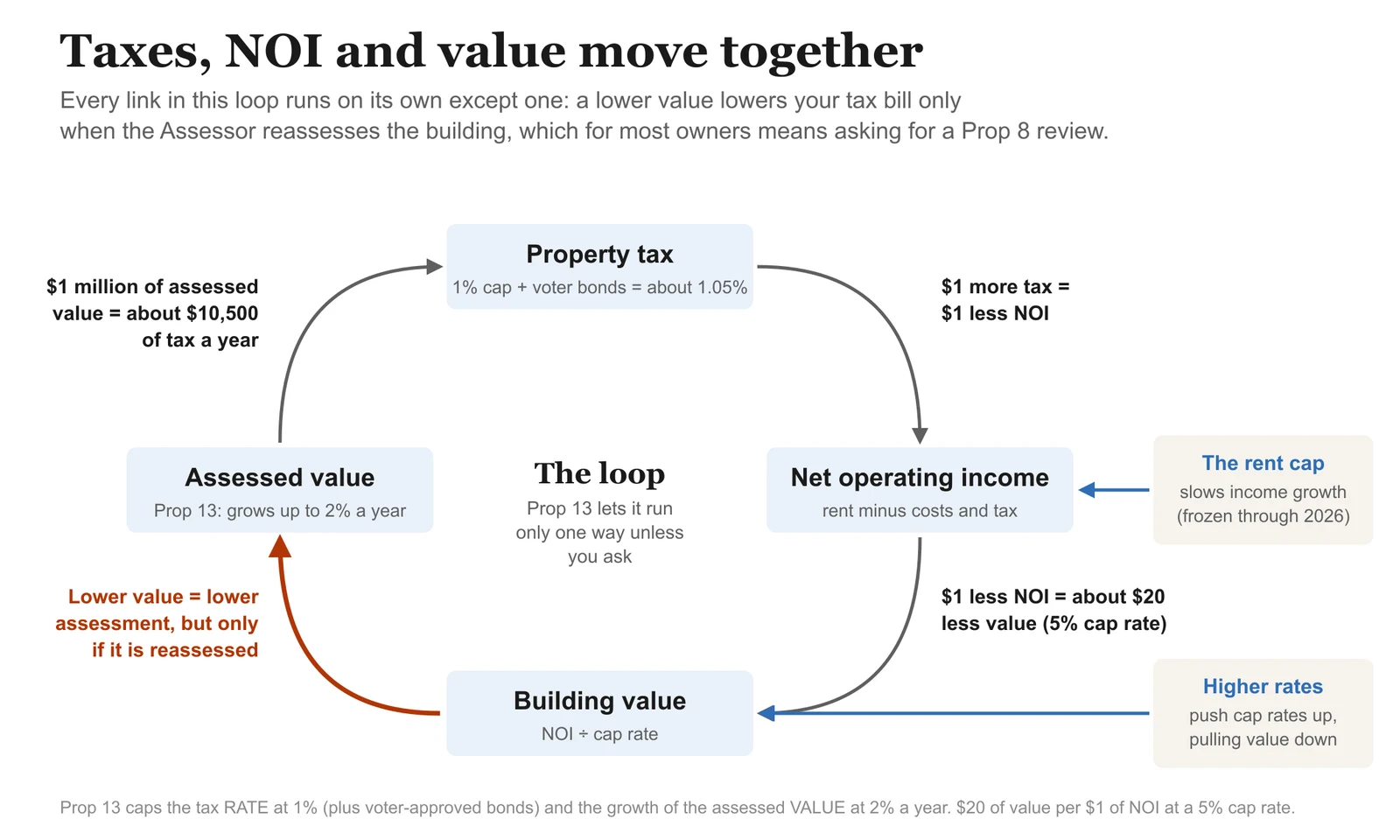
A building is worth its net operating income (NOI) divided by a cap rate, and property tax sits inside that math. Each dollar of tax is a dollar less NOI, and at a 5 percent cap rate, each dollar of NOI is worth about $20 of value. Run it the other way and value drives tax: at about 1.05 percent, each $1 million of assessed value costs about $10,500 a year.
So the four numbers form a loop: higher taxes, lower NOI, lower value and, if the building is reassessed, lower taxes again. The catch is that Prop 13 lets the loop run only one way on its own. Your assessed value keeps rising every January 1. It comes down only when the Assessor lowers it, and for an apartment building, the surest way to make that happen is to ask.
How rent control pulls value down
Rent control enters the loop at NOI. Covered rents are frozen at their December 16, 2025 levels through this year. From January 1, 2027, they can rise by only 60 percent of inflation, or 2.1 percent for 2027. Costs are not capped. During that December debate, Councilmember Mike Jordan warned that "there's absolutely nothing in the statistical basis of CPI that has anything to do with the expense loads on investment property," naming mortgage rates, taxes and repairs.
When income grows that slowly while costs compound, NOI falls behind, and buyers pay less for each dollar of it, which shows up as a higher cap rate. State law still lets rents reset to market when a unit turns over, which softens the effect but does not erase it. By our team's count of closed sales, City apartment buildings sold at an average cap rate of 4.93 percent in 2025 and 5.31 percent through September 2026 (5.22 percent across the South Coast). At the 2021-2022 peak, they traded in the mid-3 percent range. On the same income, a building that sold at 3.5 percent sells for about a third less at 5.25 percent.
The property tax line inside the rent ordinance
The ordinance even writes the loop into its own rent formula. Its fair-return petition (Section 26.90.050) compares NOI in the 2025 base year with NOI in the "current year," and only two years of property tax count: "Property taxes attributable to an assessment for the base year and for the current year." A lower assessment raises current NOI and shrinks what a petition can seek. An assessment restored later does the opposite. (Our owner's guide to the ordinance covers the rest.) Of the petition process, Councilmember Sneddon said in September, "I thought it was a formula." It is one, and your tax bill is in it.
Who is likely over-assessed
Buyers from 2021 through 2023 paid peak or near-peak prices, but the window does not close there. Until a September 2025 council memo put rent stabilization on the agenda, buyers priced Santa Barbara apartments under state law, AB 1482, which allows increases of 5 percent plus inflation, up to 10 percent a year. Five of the nine City sales in the first nine months of 2025 that reported a cap rate closed at 4.7 percent or lower. On the same income, going from 4.7 percent to this year's 5.3 percent means about 11 percent less value, before counting the rent growth the ordinance took away.
We pulled this year's tax roll for eight City apartment buildings that sold from 2021 to 2023, at prices from $2.8 million to $16.8 million. Seven are still assessed at their purchase price plus the annual increases. Only one has a Prop 8 reduction.
Owners reassessed after an inheritance or a transfer that did not qualify for an exclusion, and owners who recently added units, may be in the same position. Long-time owners are not: a building bought in 1995 carries a Prop 13 value far below market. For a rough first test, divide your assessed value by your number of units. By our count, City buildings of five or more units have sold for a median of about $408,000 a unit since January 2025. If you are well above that, look closer.
One building, two tax bills
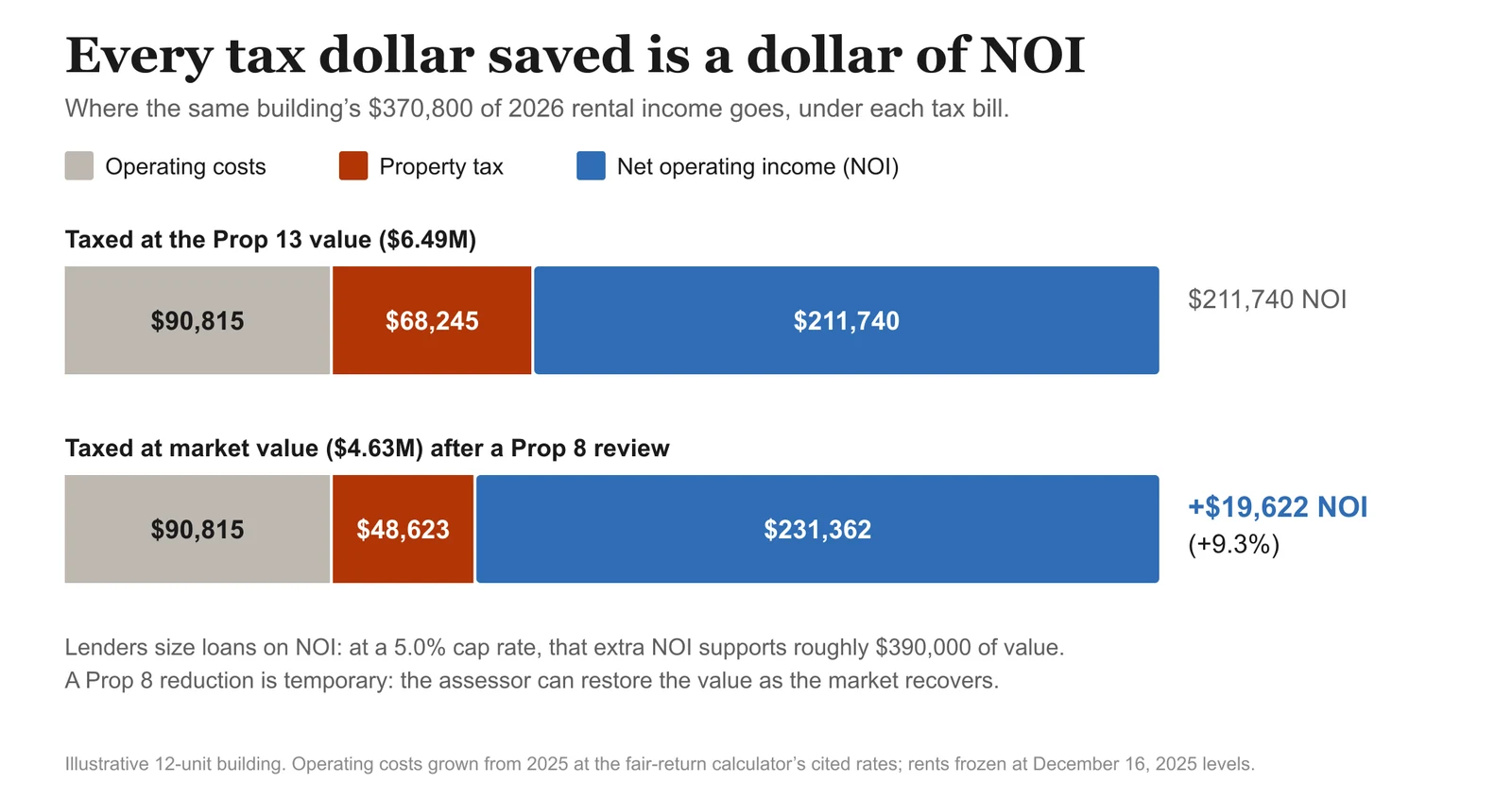
Take the 12-unit building from my talk at the July Rent Control Roundtable: $370,800 of 2025 income and $86,000 of operating costs before tax. Suppose it sold in the spring of 2022 for $6.0 million, a typical peak price of $500,000 a unit. Its Prop 13 value is now $6.49 million, so this year's bill, at about 1.05 percent, is roughly $68,200.
What would it sell for on January 1, 2026, the date this year's bill is based on? The council had voted on December 16 to pursue a rent freeze, so a buyer would have priced it on flat rents. At a 5.0 percent cap rate, it is worth about $4.63 million. By January 1, 2027, at this year's average of roughly 5.25 percent, it is worth about $4.49 million, against a Prop 13 value of $6.62 million.
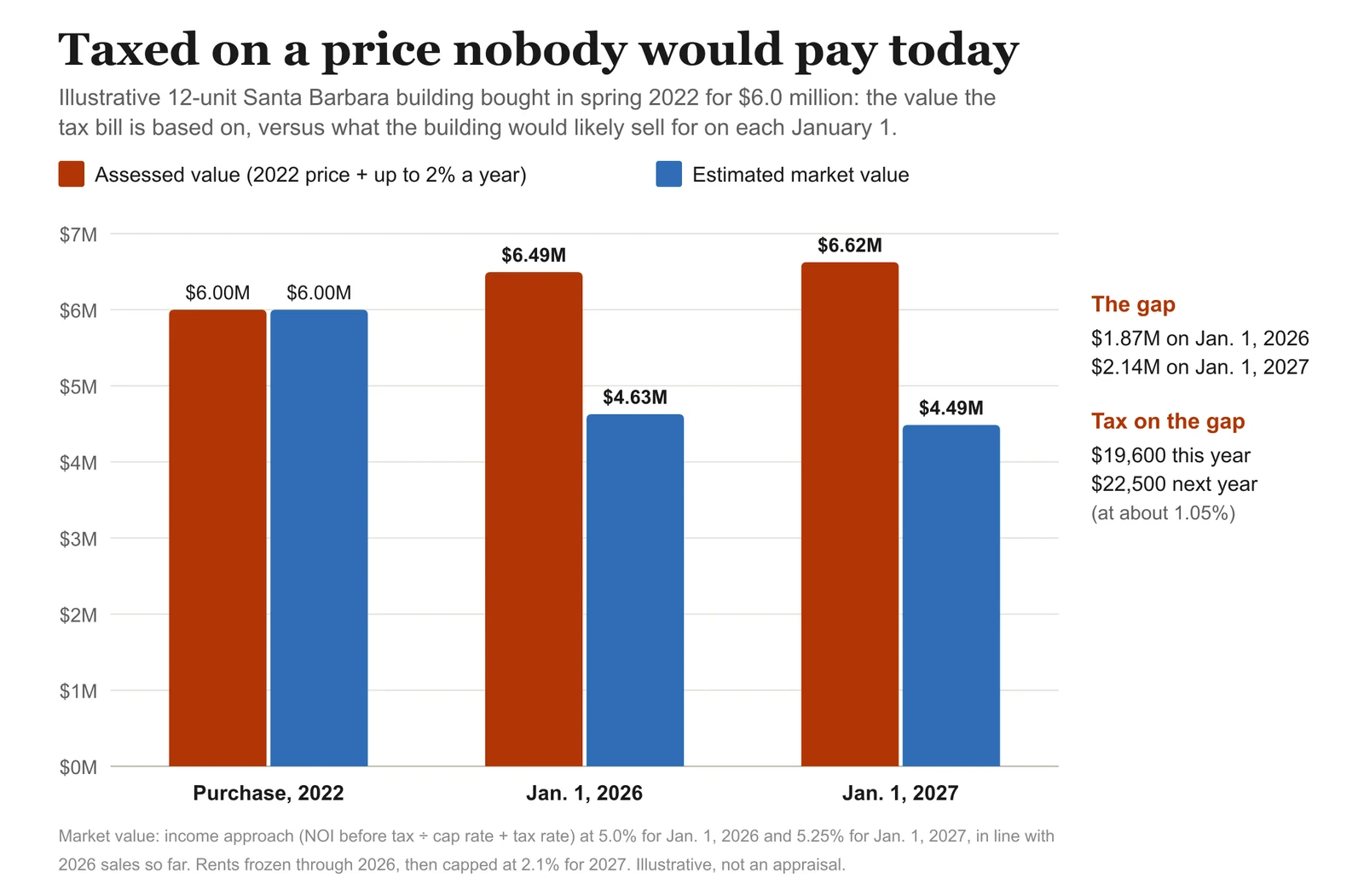
The gap this year is $1.87 million, or about $19,600 a year in tax. A Prop 8 reduction would lift NOI from about $211,700 to $231,400, a 9.3 percent increase with no change in rents, and at 5.0 percent that NOI supports roughly $390,000 more value when a lender sizes a loan.
Recent buyers are not immune. Bought in the spring of 2025 at a 4.7 percent cap rate, for about $4.97 million, the same building would be assessed about $680,000 above market on January 1, 2027, or roughly $7,200 a year in tax. The lower tax bill would also shrink the 2022 owner's possible fair-return petition, from about $13,100 a year to nothing. A Prop 8 cut lasts only while values stay down, while a petition increase stays in the rent base, so run both numbers before filing either.
How the Santa Barbara County Assessor decides value
Prop 13 resets a building to full market value only when it sells, and new construction is added at its own value. A Prop 8 review is separate. Each January 1, state law requires the Assessor to enroll the lower of your Prop 13 value and your market value, and the state Board of Equalization says assessors continually monitor the market. But our tax-roll check suggests peak-era apartment buildings are mostly not lowered unless the owner asks.
A request puts an appraiser on your building, who looks at what a buyer would: comparable sales near January 1 (up to 90 days after), the income the building can legally earn, and its condition. State rules value that income "subject to such legally enforceable restrictions as such persons may foresee," which is why the ordinance itself should count most from January 1, 2027, when the cap takes effect. The ordinance takes effect November 5 unless a referendum petition is filed first, and signature gathering is under way. Either way, this year's value rests on the market as of January 1, 2026.
How to request a Prop 8 review in Santa Barbara County
Start with the "Notice of Values" for your parcel at sbcassessor.com. If it shows your purchase price plus the annual increases, ask whether the building would have sold for that much on January 1, 2026. Two deadlines are this fall:
- Informal review. The County's "Real Property Request for Informal Assessment Review" is due November 16, 2026, with no fee listed. Include your opinion of value, three comparable sales and, for income property, three years of income and expenses, a current rent roll and asking rents on vacant units. The form warns that if the income data is not supplied within 15 working days, no review will take place.
- Formal appeal. State form BOE-305-AH, filed with the Clerk of the Board by November 30, 2026, for $65 per parcel, online or on paper (see the County's assessment appeals page). Keep paying your taxes; a win brings a refund.
An informal review does not extend the appeal deadline, so if you are late in the window, file both. A reduction covers one January 1 at a time and cannot reach back to earlier years. As values recover, the Assessor can raise it by more than 2 percent a year, but never above your Prop 13 value. For 2024 and 2025 buyers, next year's review of January 1, 2027 may be the stronger one. In a typical year, the informal review window runs July 1 to November 15 and the appeal window runs July 2 to November 30.
Frequently asked questions
What is a Prop 8 property tax review?
Prop 8 lets the Assessor tax your property on its market value as of January 1 when that value falls below its Prop 13 assessed value, your purchase price plus up to 2 percent a year. In Santa Barbara County you can ask for an informal review or file a formal appeal.
When are the 2026 Prop 8 deadlines in Santa Barbara County?
The informal review request is due November 16, 2026, with no fee listed. A formal appeal (form BOE-305-AH) is due to the Clerk of the Board by November 30, 2026, at $65 per parcel. An informal review does not extend the appeal deadline, so late in the window, file both.
Does Santa Barbara's rent control ordinance lower my assessed value?
It can lower market value, which is what a Prop 8 review measures. State rules value income subject to the legal restrictions a buyer could foresee, so the ordinance should count most for the January 1, 2027 value. For January 1, 2026, the case rests on the market itself: higher cap rates and frozen rents.
Who is most likely to be over-assessed?
Owners who bought from 2021 through mid-2025, before rent stabilization was priced in. Of eight peak-era City sales we checked, seven are still assessed at their purchase price plus the annual increases. A rough test: if your assessed value per unit is well above about $408,000, look closer.
Is a Prop 8 reduction permanent?
No. It covers one January 1 at a time and cannot reach back to earlier years. As values recover, the Assessor can raise the assessment by more than 2 percent a year, but never above your Prop 13 value.
How does a lower assessment affect a fair-return petition?
The ordinance's fair-return test counts property tax for only the base year and the current year. A lower assessment raises current NOI and shrinks what a petition can seek. In our example it takes the petition from about $13,100 a year to nothing, so run both numbers before filing either.
How we can help
A Prop 8 review turns on one question: what would your building have sold for on January 1? We answer that every day. We will prepare a free opinion of value for your building, based on the income the ordinance actually allows and current Santa Barbara sales, that you can attach to a request or give to your tax adviser. We will also show you how a lower tax bill would change a fair-return petition. We are brokers, not appraisers, attorneys or tax agents, and we do not file on your behalf. Request a free opinion of value, run the fair-return numbers at sbrso.com/my-value, or contact Steve Golis (DRE #00772218), Jack Gilbert (DRE #02197493) or Aneta Jensen (DRE #01994822) at Radius Commercial Real Estate.
Jack Gilbert (DRE #02197493) is a Senior Associate with the Golis Team at Radius Commercial Real Estate (Firm DRE #01334755) and leads SBRSO.com, a research project on Santa Barbara's rent ordinance that Radius funds. The Golis Team, which includes Steve Golis (DRE #00772218) and Aneta Jensen (DRE #01994822), specializes in apartment buildings from Ventura to San Luis Obispo County. Jack serves on the fundraising committee of the Help Save Santa Barbara Housing Committee, the coalition planning a referendum on the ordinance. This article is general information, not legal or tax advice. Questions about a specific property: jgilbert@radiusgroup.com or (805) 728-5561.