

Oxnard Multifamily: North vs. South, and Why Building Age Matters
In Oxnard, building age sets the rent cap: 4 percent for buildings certified by Feb. 1, 1995, state law after. Sales data, Census rents and 2026 rules.

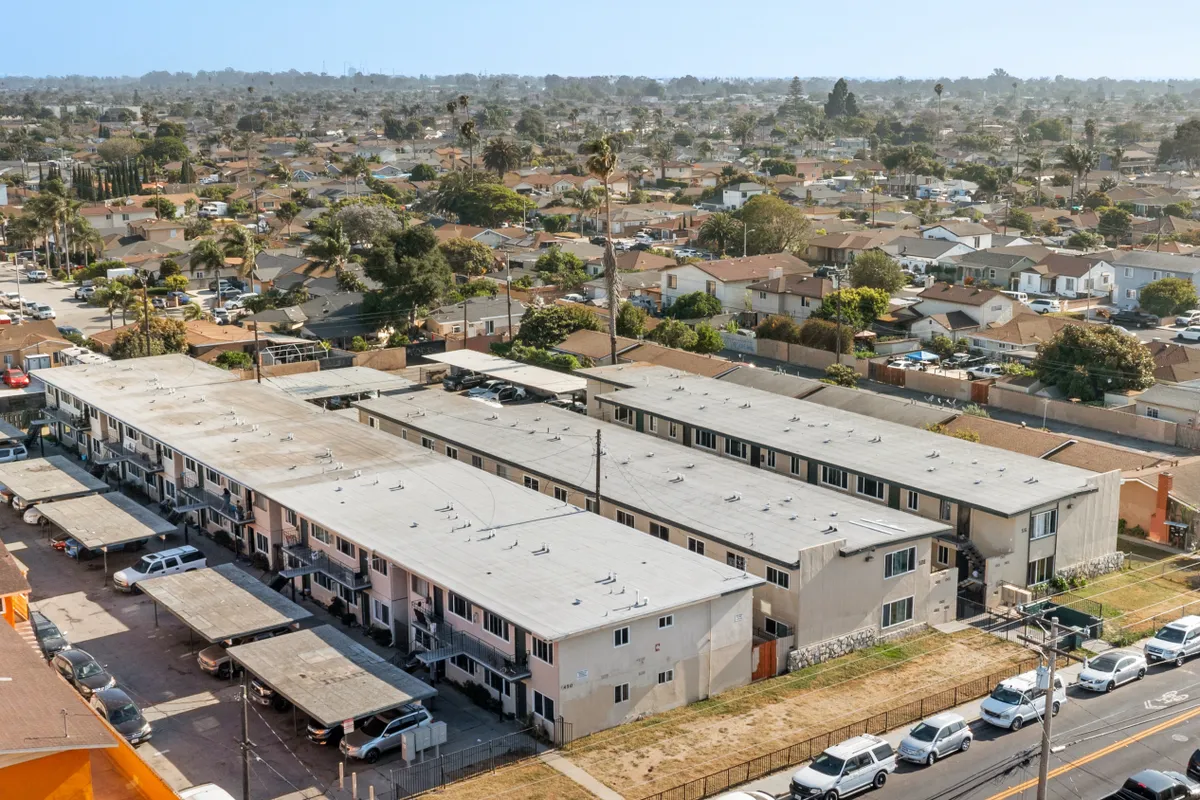
In January 2026, a 235-unit apartment community in RiverPark, built in 2016, sold for $105 million, about $447,000 per unit. From January 2025 through September 2026, the 12 older Oxnard apartment buildings in our team's count of closed sales, all built between 1950 and 1974, averaged about $218,000 per unit.
That gap is the most useful way to read north versus south Oxnard. The newest and largest rental communities sit on the north side along the 101; the south side is mostly buildings from before 1980. And since June 3, 2022, a building's certificate of occupancy date has decided whether its rents are capped at 4 percent by the City, capped by state law, or not capped at all.
At a glance
- February 1, 1995 is the line. Multifamily buildings with a certificate of occupancy issued on or before that date get one increase per 12 months, of no more than 4 percent. Of Oxnard's 421 apartment properties with five or more units, 381 (90.5 percent) were built before then.
- Later buildings follow state law. Once 15 years old, they fall under AB 1482, which allows up to 8.6 percent through July 31, 2027; younger buildings have no cap. Nearly every rental must be registered with the City.
- North and south differ mostly in building age and rent. In ZIP 93036 (the 101 corridor and RiverPark), about half of apartment renters live in buildings from 2000 or later; in 93033 (south Oxnard), about 15 percent. Median gross rent is $2,310 versus $1,857.
- Older buildings priced alike across the city. In our team's count, 12 sales of pre-1995 buildings averaged $218,280 per unit at a 5.33 percent cap rate, with north, central and south within about $4,000 per unit.
North vs. south Oxnard: building age, rents and new supply
Oxnard is Ventura County's largest city, with 198,557 residents on January 1, 2026 (California Department of Finance). Census data by ZIP code gives a clean way to compare its parts on building age and rent, though ZIP areas don't follow city limits exactly.
| Area | ZIP | Renter households in 5+ unit buildings | Built 2000 or later | Built before 1980 | Median gross rent, all rentals |
|---|---|---|---|---|---|
| North: Gonzales Road north, the 101, RiverPark | 93036 | 3,726 | 52% | 39% | $2,310 |
| Central: downtown, Gonzales to Wooley roads | 93030 | 3,693 | 39% | 50% | $1,902 |
| South: Wooley Road to Hueneme Road | 93033 | 2,614 | 15% | 70% | $1,857 |
| Beach: Mandalay, Channel Islands Harbor | 93035 | 989 | 7% | 65% | $2,460 |
| City of Oxnard | 10,942 | 35% | 52% | $2,032 |
Source: U.S. Census Bureau, American Community Survey 2020–2024 five-year estimates, tables B25127 and B25064. Gross rent includes tenant-paid utilities and covers houses as well as apartments.
The north side holds most of the newer rental stock. RiverPark, a master-planned district of about 700 acres between the 101 and the Santa Clara River, was planned partly on reclaimed sand-and-gravel mining land. Since 2018 the City has reported certificates of occupancy for 1,016 rental units in five-plus-unit buildings in ZIP 93036, 886 of them market-rate, mostly on Wagon Wheel Road and North Ventura Road (state housing progress reports).
The south side has the oldest stock, so most of its apartments fall under the 4 percent cap, and it has added just 271 rental units in larger buildings since 2018. It sits closest to the Port of Hueneme and the Port Hueneme side of Naval Base Ventura County, which the Navy calls the county's number-one employer.
Central Oxnard mixes older buildings with infill; 423 of its 429 new rental units since 2018 are deed-restricted affordable housing, outside both rent caps. The beach and harbor area has the highest median rent and few apartment buildings.
One pattern matters to buyers. About nine in ten apartment properties predate the 1995 line (Assessor data in the City's 2026 fee study), yet about 35 percent of apartment renters live in buildings from 2000 or later, because the newer communities are few but large. Every sale under $10 million in our 2025–26 count was pre-1995.
How Oxnard's rent stabilization ordinance works in 2026
The City Council adopted the Rent Stabilization Ordinance (Ordinance 3013) and the Just Cause Eviction and Tenant Protection Ordinance (Ordinance 3012) in April 2022, effective June 3, 2022. They form Chapter 27 of the City Code, since amended with detailed "substantial remodel" rules (2024) and a tenant anti-harassment article.
Which buildings are covered
The largest exemption comes from state law: under the Costa-Hawkins Rental Housing Act, no city can cap rents on a unit whose certificate of occupancy was issued after February 1, 1995, and voters rejected Proposition 33, which would have repealed it, in November 2024. Oxnard also exempts deed-restricted affordable housing, most single-family homes and condominiums owned by individuals (with a lease notice), owner-occupied duplexes, mobile home spaces, and hotel, dormitory and institutional housing. City consultants estimate roughly 14,000 rental units fall under both the cap and the just-cause rules, and roughly 8,500 more under just cause alone.
The 4 percent cap
- One increase per 12 months, no more than 4 percent. It is a flat number, not tied to inflation.
- "Rent" is broad. Parking, pet, furniture and subletting charges count, so a new parking fee uses up part of the 4 percent.
- Vacancies reset rent, with one exception. After a no-fault termination, the next tenant's rent is limited to the prior lawful rent plus intervening 4 percent increases.
- Paperwork decides validity. Increase notices must cite Chapter 27, Article II and the tenant's right to respond to a fair-return petition, and no increase takes effect while the owner is out of compliance with notice rules, habitability law or ordered repairs.
- The only way above 4 percent is a fair-return petition. The owner carries the burden, supplies an independent financial report and pays the City's review costs, and the City Manager's decision is final. Capital improvements are one factor, with no separate pass-through.
- Intentional overcharges cost three times the overcharge, plus attorney fees.
Just cause, relocation and the registry
Just-cause protection begins after 30 days of occupancy, versus 12 months under AB 1482. No-fault terminations require relocation of two months' rent or $5,000, whichever is greater, within 15 days of the notice; AB 1482 requires one month. Termination notices must be filed with the City within five days, owner move-ins require a 24-month occupancy affidavit, and a substantial remodel must involve permitted systems work or hazardous-material abatement and at least 30 days of vacancy, with a right to return.
Every residential rental must also be registered each year at rentalregistry.oxnard.gov, where owners claim exemptions, upload rent-increase and termination notices within five days of serving them, and re-register units within 30 days of re-renting.
Both articles sunset automatically on December 31, 2030, a year after AB 1482's scheduled January 1, 2030 repeal. Either could be extended; we underwrite as if both stay.
How Oxnard's cap and AB 1482 fit together
AB 1482 steps aside wherever a local ordinance holds increases below the state limit, so the City's 4 percent governs pre-1995 units. Newer units fall under AB 1482 once the certificate of occupancy is more than 15 years old: 5 percent plus the change in CPI, never more than 10 percent. Ventura County has no federal CPI index, so the California index applies; its April 2026 reading of 3.6 percent sets the cap at 8.6 percent through July 31, 2027 (see our AB 1482 guide).
The same $2,000 monthly rent (an illustrative figure) in three Oxnard buildings:
| Certificate of occupancy | Limit for a sitting tenant, Aug. 2026–July 2027 | Highest rent after one increase | Just cause |
|---|---|---|---|
| On or before Feb. 1, 1995 | 4%, once per 12 months (Oxnard) | $2,080 | City rules, after 30 days |
| After Feb. 1, 1995, over 15 years old | 8.6%, up to two increases per 12 months (AB 1482) | $2,172 | City rules, after 30 days |
| Within the last 15 years | No cap | Market | City rules, after 30 days |
Five years of maximum increases under Oxnard's cap take $2,000 to $2,433. With California inflation at 3.4 to 3.6 percent from March through August 2026, the cap sits close to inflation, so it bites hardest where in-place rents are already well below market. To size that gap: at the 5.33 percent average cap rate in our count of older-building sales, each $100 a month of rent a building can't collect is worth about $22,500 per unit ($1,200 a year divided by 0.0533).
The 2016 RiverPark community from our opening sits in the third row until about 2031, when it turns 15, after AB 1482's scheduled sunset.
What older Oxnard apartment buildings are selling for
Our team's count of closed sales of 5+ unit buildings built before the 1995 cutoff, January 2025 through September 2026:
| Area (ZIP) | Sales | Units | Average price per unit | Average cap rate | Years built |
|---|---|---|---|---|---|
| North (93036) | 3 | 65 | $218,664 | 5.71% | 1950–1962 |
| Central (93030) | 5 | 75 | $216,415 | 5.41% | 1954–1968 |
| South (93033) | 4 | 58 | $220,325 | 4.96% | 1953–1974 |
| All pre-1995 sales | 12 | 198 | $218,280 | 5.33% | 1950–1974 |
| For comparison: RiverPark, built 2016 | 1 | 235 | $446,809 | n/a | 2016 |
Simple averages of each sale, the method used in our quarterly reports. Cap rates are in-place at sale.
The samples are small, and cap rates ran from 2.51 percent, on a south-side building with rents far below market, to 7.38 percent on the north side. Location within Oxnard did not move pricing consistently; the building did, through unit mix, rents versus market, and condition.
Older Oxnard buildings cost about half as much per unit as Santa Barbara's but yield only a little more. In calendar 2025, Oxnard's nine sales averaged $215,608 per unit at a 5.17 percent cap rate, against $425,624 and 4.93 percent for Santa Barbara's South County and $270,890 and 5.03 percent for Ventura County, all by our team's count.
The market is slow. By our count, Oxnard had 10 sales of 5+ unit buildings in 2024 (five of them one 160-unit portfolio), 9 in 2025 and 5 through September 2026; its 2025 sales were 9 of Ventura County's 29 but about 6 percent of the dollar volume. Apartment List puts Oxnard's October 2026 median rent at $2,223, down 1.4 percent in a year, as new north-side communities add supply. With the 10-year Treasury at 5.19 percent on October 14, 2026, debt on older buildings costs more than the buildings yield at purchase, in our experience, so returns depend on turnover and management.
Due diligence checklist for an Oxnard apartment building
- Certificate of occupancy date. It decides between 4 percent, 8.6 percent and no cap. An ADU added to an older lot carries its own certificate and generally its own rules; confirm with the City (see our ADU guide).
- Registry file and rent roll. Get the seller's registration status, exemption filings and uploaded notices. Confirm each unit's last increase date and amount, that parking and pet charges were treated as rent, and each unit's gap to market (see how to read a rent roll).
- Turnover and renovation. No-fault terminations should show relocation paid and notices filed, and they limit the next tenant's starting rent.
- Flood and coast. Check the parcel on FEMA's Flood Map Service Center; federally regulated or insured lenders require flood insurance in a Special Flood Hazard Area. Ventura County has been working on the Santa Clara River's SCR-1 levee since FEMA found in 2009 that it fell short of certification requirements, and the City is updating its Local Coastal Program for sea-level rise.
- Insurance. Get insurance quotes before removing contingencies.
Frequently asked questions
Does Oxnard have rent control?
Yes. Since June 3, 2022, Oxnard has limited increases on most multifamily units with a certificate of occupancy issued on or before February 1, 1995 to 4 percent, once in any 12-month period. Newer buildings are outside the City's cap under state law and fall under California's AB 1482 once more than 15 years old.
How much can rent go up in Oxnard in 2026?
It depends on the certificate of occupancy. Units from February 1, 1995 or earlier can rise up to 4 percent, once every 12 months. Later units more than 15 years old fall under AB 1482, up to 8.6 percent for increases taking effect August 1, 2026 through July 31, 2027. Younger units have no cap.
Do Oxnard landlords have to register rental units?
Yes. Every residential rental in Oxnard, including newer units outside the rent cap, must be registered with the City each year through rentalregistry.oxnard.gov, where exemptions are also claimed.
How much relocation does an Oxnard landlord owe for a no-fault eviction?
Two months of the tenant's rent or $5,000, whichever is greater, paid within 15 calendar days of the notice, versus one month under AB 1482. No-fault reasons include owner or family move-in, leaving the rental business, a government order to vacate, and demolition or substantial remodel. The owner must also file a copy of the termination notice with the City within five days.
What are cap rates for Oxnard apartment buildings?
By our team's count, 12 sales of Oxnard apartment buildings built before 1995 averaged a 5.33 percent cap rate and $218,280 per unit from January 2025 through September 2026, ranging from 2.51 to 7.38 percent. Oxnard's 2025 sales averaged 5.17 percent, against 4.93 percent in Santa Barbara's South County. In our experience, the gap between in-place and market rents drives most of the spread.
How we can help
Whether your Oxnard building sits under the 4 percent cap or state law, its value comes down to its certificate of occupancy, rent history and gap to market. Request a free opinion of value or contact Steve Golis (DRE #00772218), Jack Gilbert (DRE #02197493) or Aneta Jensen (DRE #01994822) at Radius Commercial Real Estate. Our Oxnard closings are on our transactions page, with current figures on the Oxnard market page and in our Ventura County report.
Sources
- City of Oxnard, Rent Stabilization and Just Cause Evictions & Tenant Protections
- Oxnard City Code, Chapter 27: Tenant Protection and Rent Stabilization (Ordinances 3012, 3013 and later amendments)
- City of Oxnard, DRAFT Rent Stabilization and Just Cause Eviction Fee Study, June 15, 2026, July 2026 community meeting presentation
- City of Oxnard Rental Registry
- California Civil Code §1947.12 (AB 1482 rent cap), §1946.2 (just cause) and §1954.52 (Costa-Hawkins)
- California Department of Industrial Relations, California CPI percentage changes, 2025–2026
- U.S. Census Bureau, American Community Survey 2020–2024 five-year estimates, table B25127 and table B25064
- California Department of Finance, E-1 population and housing estimates, January 1, 2026
- California Department of Housing and Community Development, Housing Element Annual Progress Report data (Table A2, City of Oxnard, 2018–2025)
- City of Oxnard, RiverPark Specific Plan (revised April 2023)
- Commander, Navy Region Southwest, Naval Base Ventura County: About
- City of Oxnard, Floodplain Administration and Local Coastal Program; Ventura County Public Works, Santa Clara River Levee (SCR-1); FEMA Flood Map Service Center
- CalMatters, Proposition 33 election results, November 5, 2024
- Apartment List, Oxnard rent report, October 2026
- Federal Reserve Bank of St. Louis (FRED), 10-year Treasury yield
This article is general information, not legal advice. Confirm current rules and fees with the City of Oxnard Housing Department before serving a rent increase or a termination notice.